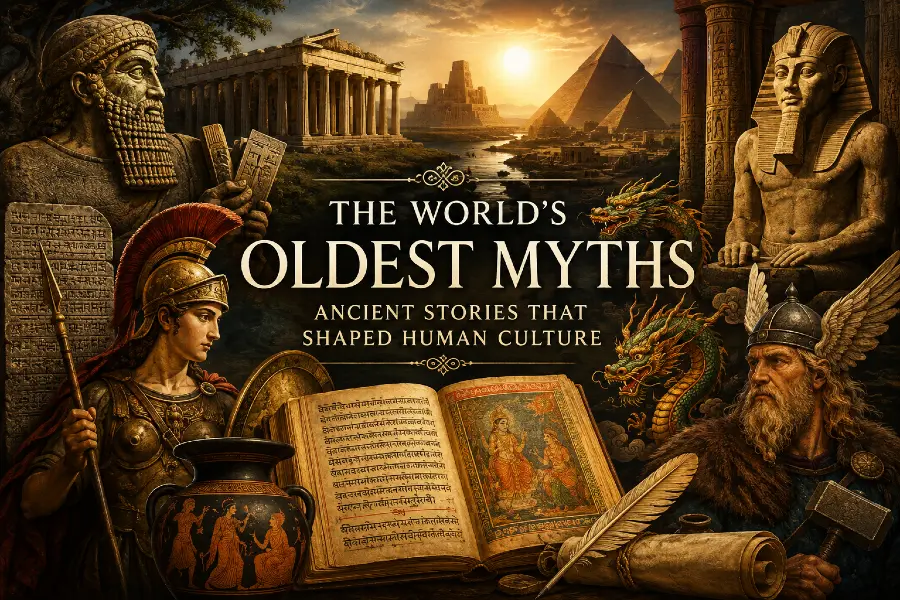
Human beings have been telling stories for thousands of years.
Long before modern books, newspapers, universities, and digital archives, people gathered to share stories about creation, heroes, kings, ancestors, extraordinary events, nature, morality, and the mysteries of existence. Some of these stories were eventually written down, while many others continued to be transmitted orally from one generation to another.
These traditions are commonly described as myths, legends, folklore, epics, and traditional narratives. Although the word “myth” is often used casually today to mean an untrue story, ancient cultures did not necessarily understand their traditional narratives in that modern sense. Such stories could carry religious meaning, cultural memory, moral lessons, explanations of natural phenomena, or ideas about society and human nature.
Determining the single oldest myth in human history is impossible. Oral storytelling existed long before writing, and most early stories were never recorded. What historians can examine are some of the oldest surviving written traditions and the cultural traditions that have continued through oral transmission.
From Mesopotamia and Egypt to Greece, India, China, Persia, Arabia, Africa, and the Americas, these traditions reveal something remarkable: although cultures developed independently across vast distances, many human societies used storytelling to explore similar fundamental questions.
Where did humanity come from?
Why does suffering exist?
What happens after death?
What makes a good ruler?
What is courage?
How should people live?
The answers were different, but the questions were remarkably universal.
What Is a Myth?
A myth is traditionally understood as a narrative involving extraordinary events, supernatural beings, gods, heroes, ancestors, or explanations of origins and the natural world.
However, mythology is much broader than stories about gods.
Traditional narratives can preserve ideas about:
- Creation
- Nature
- Death
- Morality
- Kingship
- Family
- War
- Heroism
- Justice
- The relationship between humans and the divine
- The origins of communities and traditions
Folklore is an even broader field. It can include legends, songs, stories, customs, rituals, traditional knowledge, crafts, and other forms of cultural expression.
UNESCO describes oral traditions and expressions as an important form of intangible cultural heritage through which communities transmit knowledge, cultural values, and collective memory between generations.
This is important when studying ancient traditions because not every culture preserved its heritage through writing.
Some civilizations left extensive written records. Others relied heavily on oral transmission.
Both are valuable forms of cultural history.
Why We Cannot Identify the World’s Oldest Myth
The biggest difficulty in identifying the oldest myth is simple:
Stories are older than writing.
Humans could tell stories for generations without leaving behind a permanent physical record. A story might be changed, expanded, shortened, or adapted as it passed between generations.
Writing provided a way for some traditions to survive in a more permanent form.
Ancient scribes wrote on clay tablets, papyrus, stone, parchment, and other materials. But even when historians discover the earliest surviving written version of a story, that does not necessarily mean the story itself originated at that time.
It may have already existed orally for centuries.
The Epic of Gilgamesh provides an excellent example. The surviving epic developed from earlier Mesopotamian traditions, including separate Sumerian stories concerning Gilgamesh. The British Museum describes it as one of the most important works of Mesopotamian literature.
Therefore, it is more accurate to discuss the world’s oldest surviving recorded mythological traditions rather than claim that one particular story is definitively the oldest myth ever told.
Mesopotamia and the Earliest Written Mythological Traditions
Ancient Mesopotamia is one of the most important regions for the study of early written mythology.
Located between the Tigris and Euphrates rivers, Mesopotamia became home to powerful societies including the Sumerians, Akkadians, Babylonians, and Assyrians.
Their scribes developed extensive literary traditions using cuneiform writing.
Clay tablets preserve stories about:
- Gods
- Kings
- Creation
- Floods
- Heroes
- Death
- Love
- Warfare
- The relationship between humans and the divine
Among the most famous works is the Epic of Gilgamesh.
The epic follows Gilgamesh, the king of Uruk, and his companion Enkidu. Their friendship, adventures, struggles, and eventual separation lead Gilgamesh to confront one of humanity’s oldest concerns: mortality.
Gilgamesh begins as a powerful ruler, but his experiences gradually change his understanding of life.
The story ultimately becomes a reflection on friendship, grief, human limitations, and the desire to leave something meaningful behind.
Its survival across multiple textual traditions demonstrates the enduring power of ancient storytelling.
The Mesopotamian Flood Tradition
One of the most famous stories associated with ancient Mesopotamia concerns a catastrophic flood.
In the flood narrative preserved in the Epic of Gilgamesh, Utnapishtim receives divine instructions to construct a vessel and preserve life.
Flood traditions are found in several cultures around the world.
Their similarities have attracted considerable scholarly interest, but they should not automatically be treated as identical stories or assumed to have a single origin.
Flooding was a real danger for many ancient societies, particularly those living near major rivers and coastlines. Communities naturally developed stories about catastrophic floods, survival, divine judgment, renewal, and the continuation of human life.
The Mesopotamian tradition is particularly valuable because some versions survive in very early written sources.
Ancient Egyptian Mythology
Ancient Egypt produced one of the world’s richest collections of religious and mythological traditions.
Egyptian mythology was not a single uniform system. Different cities and religious centers developed their own traditions, and ideas changed across thousands of years.
Among the most familiar figures are:
- Ra
- Osiris
- Isis
- Horus
- Seth
- Anubis
- Thoth
- Ptah
The story of Osiris, Isis, Horus, and Seth became particularly influential.
Osiris is associated with kingship and the afterlife, while Isis becomes a central figure in the story surrounding his death and restoration. Horus becomes associated with kingship and his struggle with Seth.
Egyptian mythology was closely connected with religious practice, temples, royal ideology, burial traditions, and beliefs concerning the afterlife.
The Egyptians therefore provide an important example of how mythology could become integrated into almost every aspect of civilization.
Greek Mythology and the Gods of Olympus
Greek mythology became one of the most influential mythological traditions in the later history of Western art and literature.
Its stories include gods, heroes, monsters, kings, queens, and extraordinary journeys.
Among the best-known divine figures are:
- Zeus
- Hera
- Athena
- Apollo
- Artemis
- Poseidon
- Aphrodite
- Hermes
- Demeter
- Hades
Greek mythology contains countless stories exploring human character.
Prometheus is associated with the gift of fire to humanity.
Theseus confronts the Minotaur.
Perseus faces Medusa.
Odysseus struggles through a long journey home.
Orpheus travels into the underworld in an attempt to recover Eurydice.
These stories often explore courage, loyalty, pride, love, ambition, grief, and the consequences of human decisions.
Their influence can still be seen in literature, painting, sculpture, architecture, theater, and modern storytelling.
Roman Mythology and the Roman World
Roman mythology developed within a complex cultural environment influenced by Roman traditions and interactions with neighboring peoples and civilizations.
Roman religious culture incorporated and adapted numerous traditions from across the Mediterranean.
Some Roman gods became closely associated with Greek counterparts. Jupiter was associated with Zeus, Venus with Aphrodite, Mars with Ares, and Mercury with Hermes.
Yet Roman mythology also contained distinctive traditions concerning Rome’s own origins.
The story of Romulus and Remus, for example, became one of the most famous foundation legends of Rome.
According to the traditional account, the twin brothers were abandoned and survived before becoming connected with the founding of the city.
Whether such stories are approached as mythology, legend, cultural memory, or a combination of these traditions, they reveal how societies create narratives explaining their origins.
Indian Epic and Mythological Traditions
South Asian traditions demonstrate the extraordinary diversity of global mythology.
The Indian subcontinent developed extensive bodies of literature, religious traditions, philosophical works, epics, and regional storytelling.
Among the most influential works are the Mahabharata and the Ramayana.
The Mahabharata is an enormous epic tradition dealing with family conflict, political power, morality, duty, war, and philosophy.
The Ramayana tells the story of Rama and his journey involving exile, loyalty, conflict, and the rescue of Sita.
Both traditions have been transmitted through written and oral forms and have inspired countless regional adaptations.
Their influence extends far beyond literature into theater, painting, sculpture, festivals, religious practice, and popular culture throughout South and Southeast Asia.
This illustrates an important feature of mythology:
A traditional story does not remain frozen in the form in which it was first recorded.
It can be interpreted and retold by generations of people.
Persian Mythology and the Epic Tradition
The Persian cultural world also produced an extraordinary literary and mythological heritage.
One of the most important works is the Shahnameh, or Book of Kings, completed by the Persian poet Ferdowsi around the beginning of the 11th century.
The work contains stories of legendary kings, heroes, battles, dynasties, and the struggle between forces represented through the narrative world of ancient Iran.
Figures such as Rostam became legendary heroes of Persian literature.
The Shahnameh is especially important because it preserves a vast body of Persian cultural memory and literary tradition.
Its influence can be seen in Persian painting, manuscript illumination, poetry, storytelling, and cultural identity.
Arabic and Islamic Cultural Heritage
The history of storytelling in the Arabic-speaking world is equally rich and diverse.
The tradition associated with One Thousand and One Nights, often known in English as The Arabian Nights, contains stories that developed through a long process of transmission and compilation involving multiple regions and literary traditions.
Its famous narratives include stories associated with figures such as Shahrazad, Aladdin, Ali Baba, and Sinbad, although the history of these stories is complex and many were incorporated into European editions or later adaptations at different stages.
Beyond popular storytelling, the broader Islamic civilization produced extensive traditions of biography, travel writing, poetry, historical literature, scientific writing, philosophy, and scholarship.
Cities such as Baghdad, Damascus, Cairo, Córdoba, and others became important centers of intellectual and literary activity.
Islamic civilization also developed distinctive traditions of calligraphy, manuscript illumination, architecture, poetry, and historical writing.
These traditions belong naturally within the broader study of world cultural heritage and demonstrate that the history of classical civilization extends far beyond the Mediterranean world.
Chinese Mythology and Ancient Legends
Chinese mythology includes creation stories, legendary rulers, heroes, supernatural beings, and traditions associated with the natural world.
Figures such as Pangu, Nuwa, and Hou Yi appear in well-known traditional narratives.
The story of Nuwa is associated with the creation or restoration of humanity in traditional Chinese accounts.
The legend of Hou Yi and the suns tells of a world threatened by multiple suns and the archer who responds to the crisis.
Chinese traditions also developed within a wider intellectual environment shaped by Confucian, Daoist, religious, historical, and philosophical traditions.
This makes Chinese mythology another example of how mythology can intersect with philosophy, morality, political thought, and cultural identity.
Norse Mythology and the Story of Ragnarök
Norse mythology is best known through medieval Scandinavian sources, particularly the Poetic Edda and Prose Edda, although the traditions they preserve are older.
Among the most famous figures are:
- Odin
- Thor
- Freyja
- Loki
- Tyr
- Baldr
One of the most famous narratives is Ragnarök, a series of events involving conflict, destruction, and the transformation of the cosmic order.
Norse mythology frequently explores courage, fate, loyalty, sacrifice, and the relationship between humans and supernatural powers.
The stories have had an enormous influence on modern literature, art, film, television, and popular culture.
African Mythologies and Oral Traditions
Africa contains an enormous diversity of cultural and mythological traditions.
There is no single “African mythology.” Different societies developed their own stories, religious traditions, creation narratives, ancestral traditions, heroic tales, and folklore.
Oral storytelling has played an especially important role in preserving cultural knowledge.
Stories can carry information about ancestors, social values, relationships with nature, community responsibilities, and cultural identity.
Trickster figures appear in several African traditions, although their characteristics and meanings differ from one culture to another.
The diversity of African traditions reminds us why a global study of mythology should avoid treating entire continents as though they possessed one uniform mythology.
Indigenous Mythologies and Cultural Memory
Indigenous peoples across the Americas, Australia, the Pacific, and other regions developed complex traditions concerning creation, ancestors, animals, land, nature, community, and the origins of cultural practices.
Many of these traditions were transmitted primarily through oral forms rather than ancient written manuscripts.
This does not make them less historically or culturally significant.
In many societies, oral knowledge can preserve detailed information across generations.
UNESCO recognizes oral traditions as a major part of intangible cultural heritage and emphasizes their role in transmitting knowledge and cultural identity.
When studying these traditions, it is particularly important to respect the communities that preserve them and to avoid treating sacred narratives simply as entertainment.
Why Do Similar Stories Appear Across Different Cultures?
One of the most fascinating questions in mythology is why certain themes appear repeatedly around the world.
Stories involving floods, creation, heroic journeys, enormous creatures, tricksters, extraordinary births, and journeys into the world of the dead can be found in many different traditions.
There are several possible explanations.
First, humans everywhere experience many of the same fundamental events: birth, death, family, conflict, natural disasters, love, loss, and uncertainty.
Second, cultures have interacted throughout history. Trade, migration, conquest, diplomacy, and travel allowed stories and ideas to travel between communities.
Third, different societies can independently develop similar narrative patterns because they are trying to answer similar questions.
Therefore, similarity does not automatically mean that two myths have the same origin.
Each tradition needs to be studied within its own historical and cultural context.
Myth, Legend, Religion, and History
Modern readers sometimes try to place every traditional story into a simple category:
Fact or fiction.
Ancient cultures did not always make these distinctions in the same way.
A story could contain historical memories, religious meaning, symbolism, genealogy, cultural identity, and literary development at the same time.
This is why mythology should be studied carefully.
A traditional narrative should not automatically be treated as a historical record.
At the same time, it should not be dismissed simply because it contains supernatural elements.
The story itself is historical evidence of what a community valued, remembered, feared, celebrated, or believed.
That makes mythology an important source for understanding civilization.
Myths as Cultural Heritage
Stories are among humanity’s most enduring forms of cultural heritage.
A monument can survive for centuries.
A manuscript can survive for thousands of years.
But a story can survive even when buildings disappear and manuscripts are lost.
It can live in memory.
It can be performed by storytellers, recited in families, illustrated by artists, incorporated into literature, or transformed into music and theater.
UNESCO’s work on intangible cultural heritage emphasizes the importance of safeguarding traditional knowledge and expressions that communities continue to transmit between generations.
This makes mythology more than a study of ancient stories.
It is also a study of human cultural continuity.
Why Ancient Myths Still Matter
Ancient and traditional narratives continue to influence the modern world.
Artists reinterpret ancient heroes.
Authors rewrite ancient epics.
Composers draw inspiration from legendary figures.
Architects borrow historical forms.
Filmmakers adapt traditional stories.
Museums preserve manuscripts and artifacts.
Communities continue traditional festivals and storytelling practices.
The stories survive because many of their themes remain relevant.
Human beings still think about justice, courage, leadership, mortality, family, love, sacrifice, identity, and the relationship between humanity and the natural world.
The languages and cultural settings may change, but the questions remain.
The Enduring Legacy of Ancient Stories
The world’s oldest surviving myths are only fragments of a much larger history of human storytelling.
Mesopotamian epics were preserved on clay tablets.
Egyptian traditions were recorded in texts, temples, tombs, and monuments.
Greek and Roman myths became central to later artistic and literary traditions.
Indian epics continued through written and oral transmission.
Persian literature preserved stories of kings and heroes.
Arabic literary traditions developed across a vast intellectual and cultural world.
Chinese legends were preserved through literature and cultural memory.
Norse stories survived through medieval manuscripts.
African and Indigenous traditions demonstrate the extraordinary power of oral transmission.
Together, these traditions reveal that storytelling has always been one of humanity’s most powerful ways of understanding itself.
The question is therefore not simply:
“Which myth is the oldest?”
A more interesting question is:
“What can humanity’s oldest stories teach us about the people who told them?”
They can teach us about civilizations, values, fears, hopes, artistic traditions, religious beliefs, political ideas, family structures, and the ways different societies understood their place in the world.
That is why ancient mythology remains an essential part of cultural history.
The stories may belong to distant centuries, but their legacy continues to shape literature, art, architecture, philosophy, heritage, and the way people understand the human experience.
Frequently Asked Questions
What is the world’s oldest myth?
There is no definitive answer. Oral storytelling existed long before writing, so many early myths have been lost. Some of the oldest surviving written mythological traditions come from ancient Mesopotamia and Egypt.
Is the Epic of Gilgamesh the oldest myth?
The Epic of Gilgamesh is one of the world’s oldest surviving major literary works containing mythological traditions. Its surviving forms developed from earlier Mesopotamian stories.
What is the difference between mythology and folklore?
Mythology generally refers to traditional narratives involving gods, heroes, supernatural events, creation, or religious themes. Folklore is broader and can include legends, songs, customs, rituals, crafts, stories, and other traditional cultural expressions.
Why are flood stories found in different cultures?
Floods have affected human communities throughout history, especially those living near rivers and coastlines. Similar stories may have developed independently, while others may have been influenced by cultural contact and transmission. Each tradition should be studied in its own historical context.
Did all ancient cultures have mythology?
Many human societies developed traditional narratives concerning origins, nature, ancestors, heroes, morality, or supernatural beings. However, the forms and meanings of these traditions differed significantly between cultures.
Why is oral tradition important?
Oral traditions allow knowledge, stories, customs, values, and cultural memory to be transmitted across generations. They are particularly important for cultures whose heritage was not primarily preserved through written records.
Does mythology have to be religious?
Not necessarily. Mythological traditions can overlap with religion, but they can also contain heroic narratives, cultural legends, origin stories, symbolic tales, and traditions concerning society and human behavior.
Why does ancient mythology still matter?
Ancient mythology continues to influence literature, art, music, architecture, philosophy, theater, film, cultural identity, and heritage. More importantly, many of the questions explored by traditional stories remain relevant to humanity today.